

The Editor in the Director's Chair: Inside a Cinematic Partnership
Collaboration · Glenn Hanns ACS · Josh GroomThere is a distinct brand of panic that sets in on a film set when the clock is ticking down, the light is dying, and a director realises they don't have the coverage they need to make a scene work. You see it in the frantic addition of "safety setups" — the classic manifestation of a fear of the edit suite.
But when your director spends their formative years looking at raw footage through the cold, calculated lens of an editor, the entire psychological landscape of the set changes.
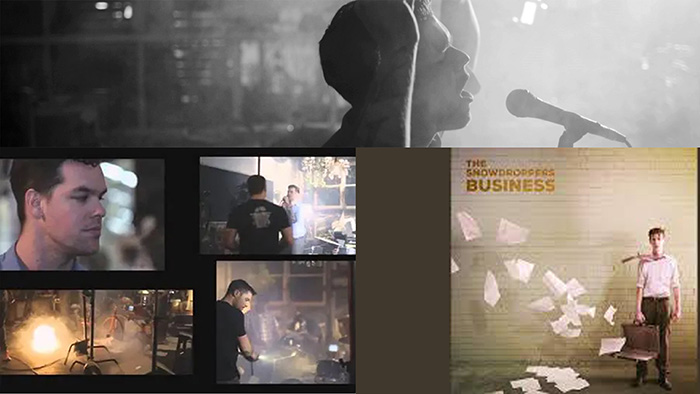
For years, my collaboration with director Josh Groom has been defined by this exact shorthand. We met at AFTRS, both completing our Master of Arts — him in editing, me in cinematography. My very first film at school was cut by Josh, and we've been working together ever since, moving between short-film dramas like Manifestation and stylised music videos for bands like Angus and Julia Stone, Birds of Tokyo, The Snowdroppers and Yves Klein Blue.
When an editor transitions to the director's chair, they don't just see a scene; they see the timeline. They aren't shooting coverage to find the story later — they are shooting strictly for the cut.
Translating the Stick Figures: Pre-Production as an Insurance Policy
Every director-DP relationship requires a shared language, and ours usually begins with some of the most spectacularly terrible stick-figure storyboards you've ever seen. Josh frames his initial concepts in raw sketches, but because of our long-term partnership, I can instantly extract the narrative intent beneath the ink.
The real magic happens when we take those raw concepts and stress-test them during pre-production. Directors naturally want to overshoot to build a safety blanket. Because I understand his editorial rhythm, my role is to look at those storyboards and ruthlessly analyse where we can combine setups or eliminate redundant angles.
Careful planning in pre-production that takes a single minute saves an hour on set — an hour where a crew of fifty people isn't standing around staring at you and the director, waiting for a decision.
To keep this organised, we rely heavily on digital script breakdown tools like Scriptation. It allows us to layer our tech recce notes, camera positions, and lighting setups directly onto the script pages. When blocking changes happen, the notes migrate seamlessly. We pair this with top-down floor plans mapping out exact actor and camera positions. If we know the exact boundaries of our frames before the crew arrives, the lighting and grip departments can pre-rig with surgical precision.
Lighting Philosophies: The Technical Toolkit
These are the three core approaches that anchor our visual language — each chosen to serve the emotional register of the scene rather than aesthetic habit alone.
| Technique | Philosophy | Technical Metric |
|---|---|---|
| Chiaroscuro & Shadow | Originating from Renaissance painting, this technique relies on strong contrasts between light and dark. We shape the subject by letting the fill side fall completely into shadow, using large soft sources highly gridded to wrap light precisely and isolate the actor against a dropped background. | Key-to-fill ratio 8:1 or higher. Shooting wide open at T1.4–T2.0 to maintain shallow depth of field. |
| Motivated Practicals | The scene is lit using sources that naturally exist in the environment — lamps, windows, computer screens — augmented subtly with off-camera fixtures to ensure the sensor gets the organic colour information it needs. | Precise Kelvin matching: cloning the exact colour temperature of on-screen tungsten bulbs (~3200K) or daylight fixtures (5600K) using wireless LED bypass units. |
| High Key Subversion | High key lighting reduces the lighting ratio so fill is almost as intense as the key. Subverted in psychological or clinical spaces, it creates an unsettling atmosphere where characters have nowhere to hide. | Key-to-fill ratio near 1:1 or 2:1. Broad, bounced sources spread an even exposure across the entire histogram. |
Playing the Rhythm: Camera Mechanics & Pacing
A major trap for young cinematographers is falling in love with a shot for the sake of its technical complexity. We've all been there: you spend three hours lighting and executing a flawless continuous tracking shot — a "oner" — only to sit in the cinema months later and realise it was hacked into five pieces because the scene needed a sharper pace.
When you share an editorial language with your director, you avoid that heartbreak. If we design a long, fluid camera movement, we build internal "soft cuts" into the blocking — a dark wipe past an actor's back, or a swift tilt past a structural column. It provides an emergency exit strategy for Josh in post without compromising the visual integrity of the frame.
Josh also has a deep affinity for simple, practical camera tricks like high-speed whip pans to bridge locations or timeline jumps.
To make these in-camera transitions seamless, we match focal lengths, lens heights, and spatial geometry exactly. It keeps the energy incredibly high and allows the camera to actively drive the narrative rhythm rather than just capturing it.
Lens Utilisation vs. Narrative Beat
| Focal Length | Narrative Application | Visual & Psychological Effect |
|---|---|---|
| 18mm – 24mm Wide | Establishing & Context | Physically involves the audience, exaggerates spatial geometry. |
| 35mm – 40mm Standard | Dialogue & Connection | Mirrors natural human vision; builds intimacy without distortion. |
| 50mm – 85mm Telephoto | Isolation & Detail | Flattens the perspective, compressing background space to trap the subject. |
Sculpting the Frame: Lighting with Intention
Josh possesses a massive, broad design sensibility that influences every project he touches. Rather than over-complicating setups with massive arrays of diffusion, our visual style favours a clean, geometric, high-contrast approach. Sculpting with shadow is often much faster than trying to achieve a perfectly flat, safe exposure everywhere — it creates immediate depth and draws the audience's eye precisely where the edit demands it.
We heavily integrate our lighting into the production design itself, utilising motivated practical sources within the frame. By relying on controllable, wireless LED fixtures tucked into the architecture of the set, we give the actors complete freedom of movement — and when we turn around from the wide shot to the close-up, we aren't spending forty-five minutes relighting the entire room.
The Ultimate Shorthand
At the end of the day, a successful director-cinematographer collaboration isn't about the gear you choose or the complexity of your lighting grid. It is about a shared philosophy.
Working with a director who understands the economy of a cut means every frame is purposeful. The camera never fights the edit; it serves it. When you achieve that level of creative alignment, you stop worrying about "getting enough safety" and start focusing entirely on what matters: telling a powerful visual story.
Glenn Hanns ACS is a Sydney-based Director of Photography specialising in feature drama, television and documentary. View his work with Josh Groom and other collaborators at glennhanns.com/showreel, read more on working with directors, or get in touch via the contact page.